International Schools
The most important mission: teaching knowledge.
// MAIN UNIVERSITIES
// London Business School
// Portucalense University
// Católica Porto Business School
// IPAM
// ISAG Business School
// Europeia University
// INSEAD Fontainebleau
// FMUP
// ESADE Barcelona
// U.Porto

+10
Universities
Professor at more than 10 universities, both nationally and internationally
+1300
Students
More than 1300 students throughout his career.
+950
Hours
Over 950 hours of classes taught across various subjects.
London Business School
// Shared Experiences
How do you define Strategy?
Jorge Jorge
What do you see as your role in this effort?
INSEAD
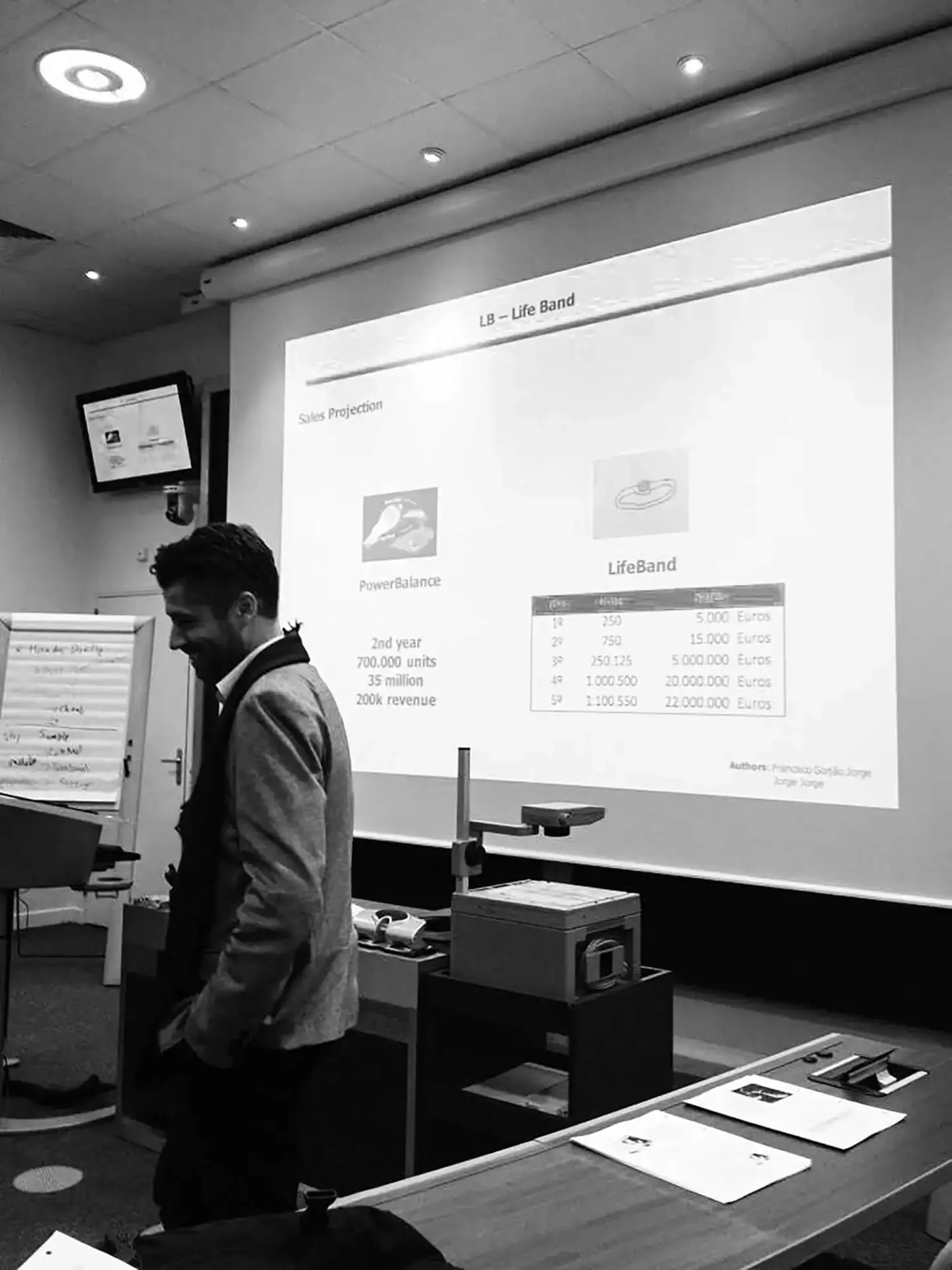
The “Life Band” (LB) project, also called “Control Your Stress”, is an innovation proposal in the health and wellness field, developed by Francisco Gorjão Jorge and Jorge Jorge within the INSEAD Innovation for Health program.
🧠 Concept
The main idea is to create a smart bracelet capable of measuring and signaling the user’s stress level in real time, promoting self-management of mental and physical health.
⚙️ Key features
· Physiological monitoring: ECG, blood pressure, oxygen saturation, body temperature, and sleep hours.
· Personalized alerts: messages such as “Go home”, “Go to sleep”, or “Go to the doctor” depending on stress level.
· Color change according to skin temperature (visual stress indicator): black, red, green, blue.
· Simple, real-time feedback, easy to interpret.
💡 Value proposition
· Simple: direct, visual feedback.
· Trendy: modern and appealing design.
· Affordable: estimated price €19.9, far below competitors like PowerBalance, Olive, or Apple Watch.
📈 Business model and projections
· Target audience: consumers concerned about health and well-being.
· Forecast: 700,000 units sold in the second year, generating €35 million in revenue.
· Main risks: technical challenges in prototype development, product quality, international patent approval, and distribution credibility.
🚀 Next steps
· Prototype creation and real testing.
· International patent registration.
· Supply chain and distribution negotiations.
· Strong PR strategy with a brand ambassador.
➡️ Slogan: “Life Band. Get Real.” — emphasizing that the bracelet helps users become more aware and in control of their own stress.
Católica Porto Business School
Postgraduate Degree in Health Management
The universe of Healthcare Marketing begins with a reflection on what marketing is and how it adapts to the healthcare context, highlighting the transition from a care-centered model to one that values institutional identity, customer experience, and strategic communication. The concept of "brand as a must-have" is presented as essential for building trust, differentiation, and lasting relationships with various stakeholders.
To illustrate how a brand's value depends on its authenticity, consistency, and ability to generate emotional connection, the effects of social media, the decentralization of communication, and the importance of reputation in an environment where more than half of what is said about a brand is no longer controlled by it are also discussed.
The theme of customer experience emerges as a strategic core of modern marketing, highlighting the need to deeply understand the audience and offer personalized and meaningful interactions, with the challenge of positioning healthcare institutions in a world marked by fragmented care, uncertainty, and a growing search for value, purpose, and trust.
In the strategic role of healthcare marketing, the importance of aligning business strategy with the needs of different audiences—from funders and regulators to patients and employees—stands out. The starting point is the "Master Marketing Model," which explores the customer journey from discovery to loyalty, reinforcing how experience, communication, and data are crucial in building value and reputation.
Creating value goes beyond price or product, requiring emotional differentiation, clear positioning, and customer loyalty strategies.
Identifying the key players influencing the sector—from funders, regulators, and partners to professionals and citizens—is vital for a systemic view of the healthcare market. This involves exploring the interaction between supply and demand, the weight of economic, legislative, social, and technological forces, and the role of organizations in responding to these dynamics with information, positioning, and strategy.
In formulating marketing strategies—from SWOT analysis to loyalty and branding—presenting an integrated model that includes market knowledge, positioning, service level, value creation, and communication, essential tools such as the Master Marketing Model, segmentation and targeting, customer experience, customer insight, and data measurement need to be developed, reinforcing the importance of data-driven decisions aligned with the institutional mission.
The relationship between health and media communication, demonstrating how public perception is shaped by the media and how information management can protect or reinforce an institution's reputation, analyzes the importance of anticipation, rigor, transparency, and agility in health communication, and the role of professionals as ambassadors of credibility and trust.
It is relevant to explore the concept of corporate communication, which integrates everything from organizational and internal communication to media relations, awareness campaigns, and digital presence. Best practices in storytelling and crisis management are analyzed, showing how transparency and narrative consistency strengthen reputation and audience engagement. Communication is presented not only as an informative tool but as a strategic asset that influences perceptions, behaviors, and decisions.
Marketing and communication, when aligned with the organization's clinical and human objectives, can transform relationships with the community, generate public value, and reinforce the identity of the national health service.
ISAG
Postgraduate Degree in Health Management
To be a good leader, you don't need to be the best at everything.
On the contrary, extraordinary leaders are those who seek out people who are better at different things and put them on the same team!
FMUP
Strategic Communication and Marketing in Healthcare
Portucalense
Strategic Marketing
Marketing strategy is presented as a structured process that includes market and competitor analysis, diagnosis, goal setting, and marketing mix development. Within this process, communication strategy emerges as one of the operational phases, oriented towards translating the brand positioning and reaching the defined target audiences. The fundamental difference between the two lies in the nature of the focus: marketing defines the "what" and the "for whom," while communication operationalizes the "how"—that is, how to transmit the brand's value proposition to its various audiences.
The concept of Integrated Marketing Communication (IMC), which is now seen as a 360º system that combines traditional, digital, and action marketing methods. This integration requires not only rigor and strategy but also creativity and innovation to create new forms of impact. The evolution of the last few decades shows a transition from campaigns centered on advertising and traditional media to complex ecosystems, in which different tools, channels, and formats coexist, reflecting the multiplicity of touchpoints between brands and consumers.
IPAM
Advertising | Business Network | Communication Management
What is life without this amazing students anyway?
Thank you all for this amazing journeys.